
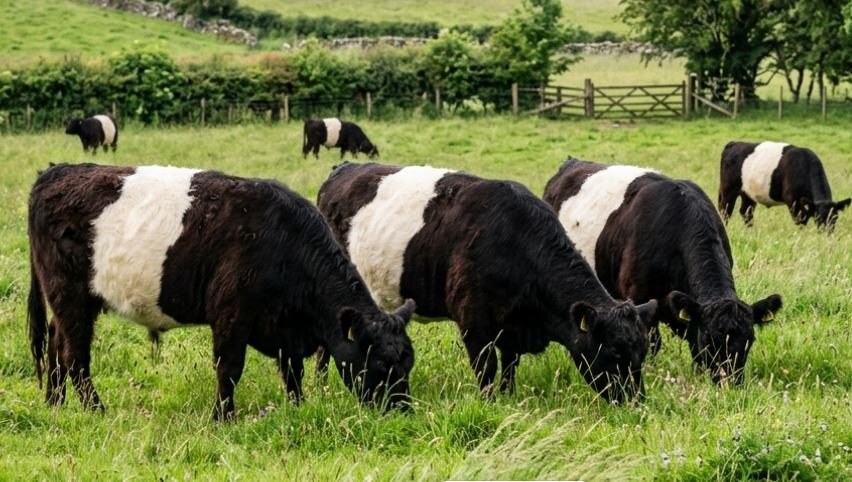
Galloway cattle were born in those rugged mountains of southwest Scotland. The local cattle were renowned for their toughness and thriftiness. They could also endure harsh conditions. While the native cattle varied in body color, body form, and horn style, breeders slowly selected those with the best characteristics. Between the late eighteenth century and the early nineteenth century, this breeding method resulted in the evolution of the Galloway. As a uniform naturally polled beef strain with a remarkable environmental sensitivity. In the course of time, Galloway cattle became well recognized for their capacity to flourish on rough pasture. As well as their strong maternal instincts, and for the production of top-quality beef. The official herdbook of the breed was published in 1877.
Origins of belted galloway cows
The precise origins of the striking color-belted pattern are still unclear. The distinctive pattern is a wide white band that encircles a solid-colored body, which can be seen in a variety of cattle breeds in various regions around the globe. It is evident that most of the Lakenvelder cattle are from the Netherlands, which is known within North America as the Dutch Belted. Certain breeds, like those of the Welsh Black and the Kerry breeders, opted against the belted patterns, and they were eventually removed from the populations. In contrast, the Belted Galloway took the opposite route. The belted pattern was accepted and regarded as the standard of every animal belonging to the breed.
Belted galloway color and similarity
Herd books that were separate specifically for belted cattle were created within Scotland by 1928. This decision to split the strains based on color marks the official beginning of what is now the Belted Galloway as its own distinct breed. However, despite this distinction, this Belted Galloway remains very similar. The standard Galloway and shares many of its characteristics, such as its toughness and thriftiness, as well as the ability to flourish on rough forage. The most popular color is black and white belt. But the breed can also be seen in dun and red, and both are paired with the iconic white band.
Belted Galloways first came to North America during the 1940s, and their striking design and robust constitution soon gained the attention of admirers. Breeders in the United States founded the Belted Galloway Society to help promote and protect the breed. They helped keep their place in American cattle farming.
Belted galloway facts
In spite of its striking appearance In spite of its striking appearance, the Belted Galloway is a remarkably belted galloway cows used for well-adapted to harsh, cold environments and has been shaped by generations of surviving within the harsh Scottish highlands. One of the most obvious signs that this is true is in the coat that animals wear in winter. When temperatures drop, the Belted Galloways develop an incredibly thick and shaggy “double coat,” consisting of a coarse, long outer layer, and an undercoat of soft, dense. The insulation naturally traps warmth near the body. It dries out snow and rain, and allows the cattle to flourish outdoors during harsh winters. The benifit is without the need for additional shelter.
Weight
As the warmer months approach, the breed sheds its bulky coat and shows an elegant summer coat beneath. This transition offers Belted Galloways a unique advantage. So they are able to withstand temperatures far better than breeds. So they are cold-adapted and are therefore able to handle various climates and geographical regions.
In terms of dimensions, galloways are considered a medium-framed breed. The average weight of cows is around 1,000 pounds, whereas mature bulls weigh around 1,600 pounds. This size is moderate and is a key factor in their efficiency, because they are able to convert rough forage into high-quality beef. Cow also imporve size without the weighty requirements for feed of bigger breeds.
The cows are admired because of their maternal instincts. They easily calve, give plenty of milk, and are exceptionally attentive to their mothers. Even going so far as to protect their calves from predators when they are threatened. As with their traditional Galloway relatives, they are polled. This means that they are born without horns. This improves the safety of both handlers and animals and reduces the necessity of dehorning. This further highlights the practical benefits of this breed to farmers.
Scottish Breeds
Belted Galloway beef enjoys a prestigious reputation for quality. And stands with the traditional Galloways as well as different Scottish breeds. Since the cattle are able to grow and mature well on their own, their meat is naturally incorporated into premium specialty markets. Which include organic and grass-fed niches. These markets are a reward for producers who raise livestock in forage-based, low-input methods. And the Belted Galloway is well-suited for this kind of system. The result is a beef that is lean, delicious, and well marbled,. It has qualities that attract people who are looking for a natural and organically raised product.
The physical structure of the breed adds additional value to the butcher’s block. Belted Galloways sport a longer body structure, which can increase the percentage of premium cuts in the hindquarter and loin. This means that a larger portion of every carcass is offered as premium steaks or roasts. Thereby increasing the amount of money farmers earn for each animal, in conjunction with the breed’s effectiveness in coarse forage. This feature can make Belted Galloway an economically attractive choice for producers who are focused on high-quality over volume.
Market Demand
The worth that comes from Belted Galloway is immense. Belted Galloway does not end with its meat. The hides are prized due to their attractive appearance. They can be made into carpets and other items of decor. The bright white belt, set against a dark, textured coat. It paired with the animal’s distinctively long, shaggy, and thick hair, provides these products with a distinct appearance. The productivity distinguishes them from other specialty leathers and home furnishings markets. This way, the eye-catching coat that is the hallmark of the breed also provides an additional source of income. The revenue that allows farmers to make the most profitable belted galloway cows used for they keep.
Europe Belted Galloway
In Europe, the Belted Galloway is classified as a “light grazer,” a phrase that describes its low body weight and gentle footprint on the earth. Since the breed is less heavy than commercial livestock. It is able to traverse wet, marginal, or sensitive areas without causing the compaction of soil, poaching, trampling, or the damage. It is heavier animals typically leave behind. This is what makes the Belted Galloway an ideal partner in conservation grazing, when the objective is to keep healthy pastures. The safeguard fragile habitats rather than increase output.
The land managers of the world are drawn to the breed’s capability to be productive on terrains. That could rapidly degrade under the weight of larger animals.
The usefulness of the breed in the field goes far beyond its small tread. Belted Galloways are adept at browsing as well as grazing;. They are willing to eat bushes and rushes as well as fine, low-value grasses. Many other breeds don’t leave. Their appetite for variety is what gives the breed a significant part in managing grasslands and diversification. By cutting down grassy vegetation and grazing plants that would otherwise occupy the field, they create spaces for finer grasses as well as wildflowers to flourish. This results in a more diverse and balanced sward which will benefit livestock production and biodiversity. If farmers are looking to restore the overgrown or worn-out pastures, the natural ability to clear is a huge advantage and reduces the need for cutting with a machine and chemical treatments.
Cows with white band
In addition to these advantages In addition to these strengths in practicality. In addition to these practical advantages, the Belted Galloway offers qualities that are particularly welcoming to newcomers. It is extremely durable and thrives outdoors all year round, without the need for extensive housing or a hefty amount of management. The calm, mellow disposition makes it comfortable to handle, a crucial aspect for those who are still developing confidence in livestock. In addition, add the stunning belted coat, its striking white band that encircles the dark body, and it’s clear that it is no wonder that the Belted Galloway has become a favourite among farmers at the beginning. It is easy to handle, low maintenance, and certainly attractive and rewarding. It is an excellent introduction to the cattle industry and still provides an ecological and agricultural benefit.
Commercial food manufacturing relies on a very limited selection of poultry and livestock breeds. A few highly specialized animals, specifically bred to produce maximum production under controlled conditions, provide the majority of the world’s milk, meat, and eggs. The focus on a handful of top-performing breeds has led to significant gains in efficiency, even for a short time. Still, it has also resulted in a vulnerability that is not obvious. If the production system is built on an insufficient genetic basis, the entire food system is vulnerable to the risk that a diversifying population may take on.
Health Risks and Cautions
The risks of having a small population of genes are very real and well-documented. Breeds that are selected primarily for efficiency often fail to acquire the characteristics that made their ancestors more resilient, like disease resistance, fertility, hardiness, and the capacity to thrive on rough or fluctuating forage. A new disease, a changing climate, or an interruption to the supply of food could spread rapidly in a uniform population, since animals with the same genetics are likely to have the same weak points. Genetic diversity serves as an insurance policy that is natural.
The greater the variety of traits that are available to different breeds, the better agriculture is able to adapt when the environment changes and needs change.
This is where the rare and heritage breeds demonstrate their worth. Animals such as the Belted Galloway possess traits that have been refined over time in challenging environments, such as the ability to tolerate cold, the efficient conversion of poor forage, strong maternal instincts, and a healthy body.
These characteristics may not be as belted galloway cows used for in the current era of growing intensively, but they provide an unbeatable source of ability to adapt. If future circumstances call for cattle that are able to thrive outdoors in marginal areas with only minimal inputs, the breeds that are preserved today may become the primary resource of tomorrow. If a breed is gone, its distinctive genetic makeup is lost forever.
Future Generation
Organisations like The Livestock Conservancy play an important role in preventing loss. Through identifying breeds that are endangered and keeping accurate records, assisting livestock farmers who raise them, and increasing their value on the market, the Conservancy assists in keeping rare and historic animals alive and productive, rather than being kept as artifacts. The Conservancy’s work helps ensure that the genetic wealth accumulated in breeds such as Belted Galloway remains available to future generations.
Protecting this diversity isn’t an issue of nostalgia. It’s an investment in the strength of agriculture as well as the safety of our food supply. In an evolving world, the species that are protected today could have the characteristics needed to provide food for the world in the coming years. Read more stories like this