
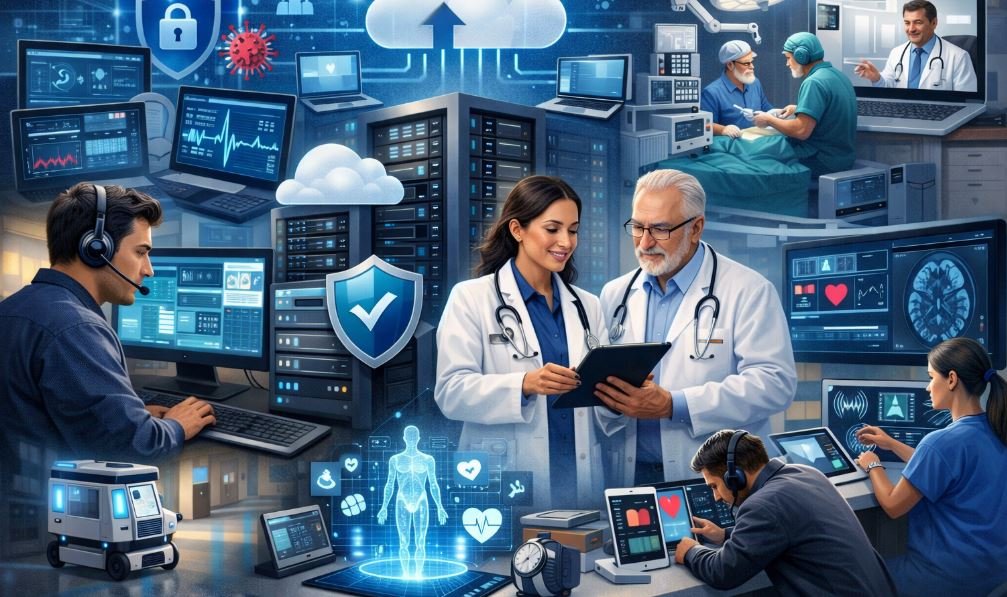
In the rapidly changing Healthcare landscape today, technology is revolutionising the way that care is provided, managed and enhanced. The incorporation of IT services and support within Healthcare facilities has evolved from being merely an asset to becoming essential. From managing electronic health records (EHRs) to guaranteeing strong cybersecurity, IT infrastructure serves as the foundation for effective, patient focused healthcare provision. This article offers an extensive summary of what is generally part of IT services and support for a contemporary Healthcare facility
- Electronic health records (EHR) & Practice Management Systems
A key service of Healthcare IT is the implementation and administration of electronic health records’ (EHR). These systems electronically keep patient information such as medical history, diagnoses, medications, treatment plans, immunization dates, allergies, radiology images and lab test results. EHRs grant healthcare providers immediate access to essential data, improving diagnostic precisions, care collaboration and patient safety.
Alongside EHRs are Practice Management System (PMS) – which streamline essential administrative duties like scheduling appointments, handling billings and processing insurance claims. Integrated systems such as Healthie enhance workflows by incorporating EHR, intake forms, care planning, and billing within one platform. This integration enhance operational effectiveness, minimises mistakes, and facilitates improved patient management
- Health information exchange (HIE)
Health information exchange (HIE) denotes the safe electronic sharing of patient health data among various Healthcare institutions. HIE systems are essential for coordinated treatment delivery as they allow real time data access among general practitioners, specialists, laboratories, and hospitals.
By utilising HIE, providers can eliminate unnecessary testing, obtain comprehensive patient insights, and react more promptly during emergencies. Nonetheless, establishing HIEs necessitates skilled IT assistance to tackle interoperability issue, guarantee adherence to data privacy regulations, and uphold secure data transfer
- Cybersecurity and regulatory compliance
One of the most important components of Healthcare IT is cybersecurity. because healthcare organisations hold so much sensitive personal health information (PHI), rendering them a key target for cyberattack. IT support services are tasked with executing multi-tiered cybersecurity measures, including:
- Firewall and network protection
- Data encoding (both stored and in motion)
- Authentication involving multiple factors (MFA)
- Systems for detecting intrusions in real time
- Consistent security evaluations and risk assessments
Moreover – healthcare professionals are asked to adhere to strict regulations’ like HIPAA in the U.S or GDPR in the EU. Failure to comply can lead to significant financial fines and harm to individuals’ reputation. An effective IT team guarantees that all systems comply with current regulations’ and performs regular compliance assessments.
- Telehealth and remote patient monitoring
The need for virtual care solutions has surged dramatically particularly following the covid 19 pandemic. Telehealth services allow patients’ to connect with Healthcare providers remotely through video calls, chat services or mobile apps. Moreover, remote patient monitoring enables the ongoing observation of health indicators’ like blood pressure, glucose levels and heart rate.
To facilitate these services – IT infrastructure should incorporate high speed connections, secure video conferencing solutions, cloud data storage, and mobile application integration. IT teams guarantee that these systems adhere to HIPAA regulations and work seamlessly with current EHR systems to ensure continuous care.
- Advanced data analytics and decision support systems
Healthcare produces vast quantities of data each day, ranging from patient files and diagnostic reports to treatment results and Insurance claims. Sophisticated data analysis tools assist in understanding this information to obtain practical insights.
By utilising IT services, Healthcare professionals can implement clinical decision support systems (CDSS) that evaluate patient information to aid in diagnosis, forecast disease risks, and suggest evidence based treatment alternatives. These instructions enhance patient results and operational effectiveness while simultaneously lowering expenses and unnecessary procedures
- Infrastructure management and clouds services
A dependable and scalable IT infrastructure is crucial for backing all digital healthcare activities. IT services oversee both physical and virtual infrastructures, which encompasses:
- Servers and user terminals
- Network equipments (routers, switches)
- Storage systems for data
- Power backup systems and cooling equipment
An increasing trend towards cloud computing is evident in Healthcare, since cloud services provide flexibility, scalability, improve data recovery, and cost efficiency. IT support teams manage cloud migration, set up virtual servers, control user access, and offer ongoing monitoring to guarantee uptime and efficiency
- 24/7 technical support and monitoring
Healthcare facilities function around the clock, and any IT issue can greatly affect patient treatment. Consequently, ongoing technical assistance and system oversight are crucial elements of Healthcare IT services.
Dedicated IT support teams provide 24/7 help for all scripts and software problems, hardware failures, or network issues. Automated monitoring tools are utilised to detect and rectify potential issues in advance, preventing interruptions to operations
- Disaster recovery and business continuity planning
System breakdowns, cyber intrusions, or natural calamities can disrupt Healthcare functions and endanger patient safety. IT support services encompass the creation and execution of strong disaster recovery and the business continuity strategies aimed at reducing downtime and preventing data loss.
Essential components consist of:
- Frequent data backups (local and cloud based)
- Duplicate servers and networks
- Established roles and protocols for responding to crisis
- Objective for recovery time (RTO) and Objective for recovery point (RPO)
A solid disaster recovery plan guarantees that healthcare services continue without disruptions and that patient data remains secure during unexpected incidents
- Regulatory and legal compliance support
Steering through the intricate maze of Healthcare laws demands knowledge. IT services assist in ensuring that digital systems adhere to local and global compliance standards such as:
- HIPAA (Health Insurance portability and accountability act)
- GDPR (General Data Protection Regulation).
- HI-TECH (Health information technology for Economic and Clinical Health Act)
- Standards for IT from the local ministry of health
This entails preserving audit trails, regulating access to confidential information, overseeing consent records, and guaranteeing secure communication pathways
- Patient engagement and communication tools
Actively involving patients in their care has demonstrated enhancements in results and satisfaction. IT services facilitate the creation of digital tools including:
- Patient portals for retrieving records, lab results, and communications.
- Platforms for scheduling appointments
- Requests for prescription refills
- Appointment reminder via email and SMS
- Surveys for feedback and satisfaction
These tools not only enable patients but also lessen administrative workloads and missed appointments
Final thoughts
The significance of IT services and support in Healthcare is broad and essential. Protecting patient information, facilitating telehealth and guaranteeing smooth operations and adherence to regulations – IT serves as the driving force behind the advancement of contemporary healthcare. By investing in strong, effectively managed IT infrastructure, Healthcare facilities can improve patient care, boost operational efficiency, and secure their services for the future in a swiftly changing digital landscape.
As the healthcare sector increasingly adopts innovation, the demand for skilled IT assistance will continue to rise. Collaborating with seasoned IT experts guarantees that your facility stays secure, complaint, and technologically equipped to address both present and future Healthcare challenges