
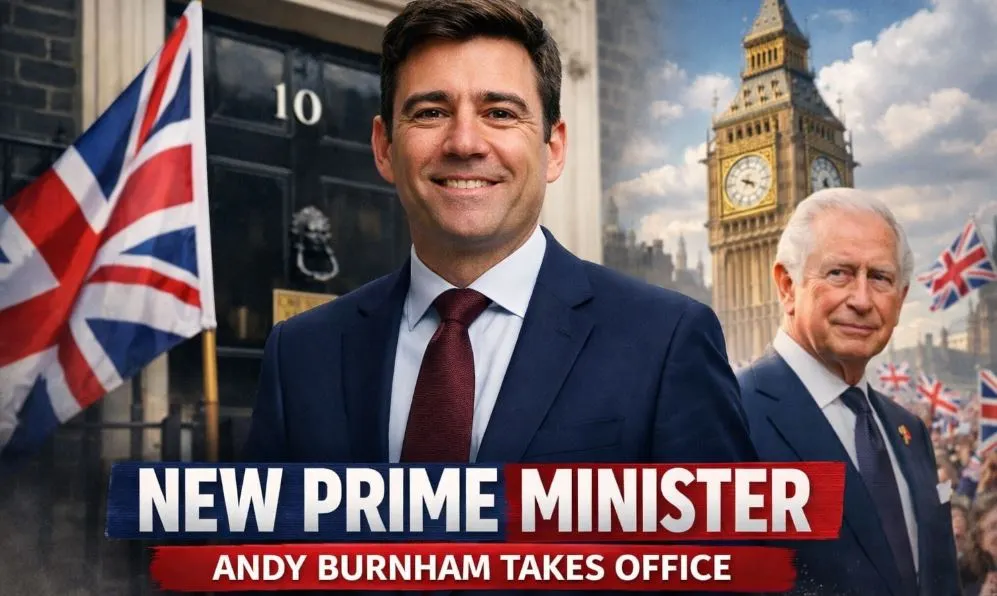
The UK has entered a new chapter in 2026 for its political history by having Andy Burnham officially announced as the country’s new PM after Keir Starmer stepped down. Burnham, who was previously referred to as the Mayor of Greater Manchester, has long been a prominent Labour and lower community figure, and his rise to the prime minister position is the seventh leadership change in less than 10 years.
The prompt change in leadership in 2026 highlights the political instability Britain has survived in recent years, with both analysts and voters alike wondering if Burnham is able to bring stability in a time when his predecessors have struggled. The decision to appoint him by Charles III as King Charles III was greeted with cautious optimism, as many people hope for a government that will solve the looming cost-of-living crisis.
One of the first actions taken by Burnham was a massive cabinet overhaul, which signalled the end of the style of leadership that Starmer has been displaying. Some key figures were repositioned: John Healey was named Chancellor, Ed Miliband took over as Foreign Secretary, Yvette Cooper assumed the job of Health Secretary, and Angela Rayner was appointed Housing Secretary.
The appointments are a reflection of Burnham’s desire to mix experience and reform by bringing back veteran politicians and promising fresh energy. The new administration has already provoked controversy, with supporters applauding the return of names they know but critics warning that reusing old faces might not bring the changes voters expect.
Political Agenda
Burnham’s political agenda is focused on combating his country’s cost-of-living problem that has seen millions of people struggling with increasing energy costs as well as transport fares and the cost of housing. He has promised immediate relief measures including the provision of subsidies for bus travel and limits on energy prices as well as a longer-term plan for reforms to the economy.
The focus on practical solutions is a hit with people across the UK. However, experts warn that the funding of these plans will need significant fiscal or borrowing. The main challenge for Burnham is to balance his ambitious promises with fiscal accountability; this is a challenge that has been a challenge for many leaders before him.
In the international arena, Burnham inherits a complex scene. The UK has to contend with continuing conflicts within Ukraine as well as delicate talks with Iran and the need to rebalance relations with the Trump Administration in the United States. The decision to nominate Ed Miliband as Foreign Secretary implies a more radical approach to climate diplomacy as well as global cooperation; however, questions remain regarding the way Britain will position its sovereignty in matters of security. Some observers say that Burnham’s foreign policy is likely to be tested soon, since global crises require a swift and decisive response from Downing Street.
Perhaps the most inconvenient for Burnham is removing his Digital ID initiative, which was expanded under Starmer. While privacy advocates hailed the decision as a win for civil liberties, opponents say that the decision could slow the progress in modernizing public services.
The decision shows Burnham’s willingness to depart sharply from his predecessors with the possibility of political repercussions. As he begins his tenure as the new leader, the UK public as well as the world will be keeping an eye on the situation to see if Burnham will turn bold statements into concrete outcomes, or if his term will turn into another short-lived episode in Britain’s turbulent political history.
Who will benefit from Andy Burnham’s leadership?
In short, the citizens or foreigners who will benefit most from Andy Burnham’s leadership are working‑class families and metropolitan communities laboring with the cost‑of‑living crisis. His policies are focused on lowering energy bills, improving public conveyance, and extending affordable housing for everyone, which directly help everyday nationals rather than large establishments.
Northern England, especially cities like Manchester and Liverpool, is expected to gain from his regional action agenda, as Burnham has long advocated for fair funding outside London, but he thinks the same for all regions.